
Introduction
A high-pressure oxygen connection may look like a simple hose, but in an oxygen filling plant, the hose is part of a system where pressure, gas compatibility, fittings, cleanliness and installation all matter.
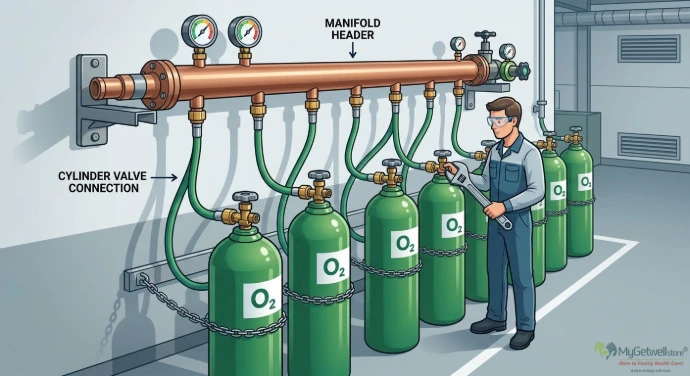
For medical-gas suppliers, cylinder filling operators, biomedical engineers and hospital technical teams, choosing the wrong hose can create problems such as leakage, connection failure, excessive bending or incompatibility with the operating pressure. Oxygen also requires particular attention to contamination because it supports combustion more readily than ordinary air. WHO describes medical oxygen systems as a complete chain involving oxygen production, distribution, regulation, delivery and monitoring—not simply a source and a pipe.
So, what should you look for in an oxygen filling hose?
This guide explains the purpose of a high-pressure tail pipe, how it connects a cylinder to a manifold, what to check before installation, how hospital oxygen piping differs from cylinder-filling connections, and where questions such as water traps fit into an oxygen system.
The goal is simple: help you understand the equipment so that you can make technically informed purchasing and maintenance decisions.
Understanding an Oxygen Filling Plant Hose
What is an oxygen filling hose tube?
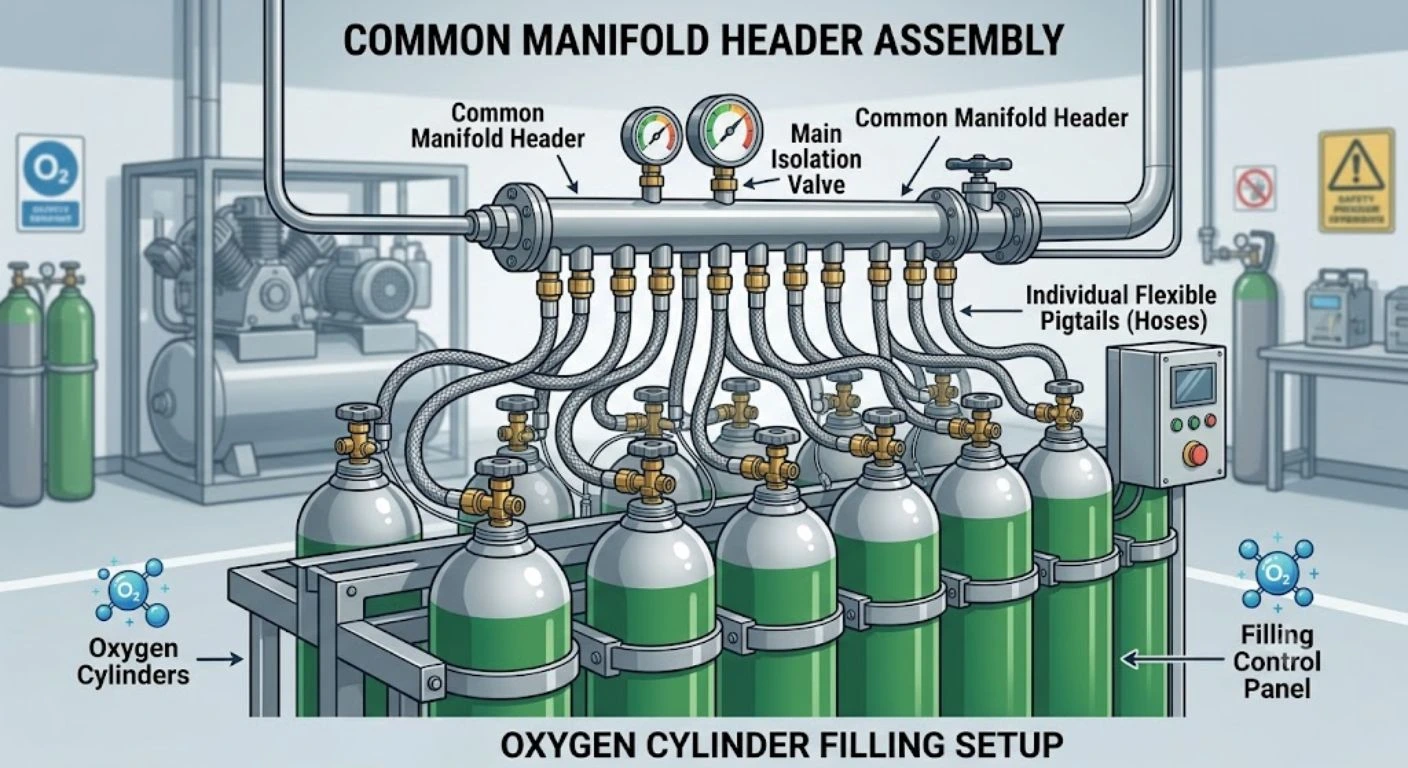
An oxygen filling hose is a flexible connection used in an appropriately designed high-pressure oxygen transfer or cylinder-filling system. In a typical cylinder-filling arrangement, an individual cylinder is connected to a manifold header through a suitable filling pigtail or tail pipe.
Unlike low-pressure tubing used to deliver oxygen to a patient, a cylinder-filling hose must be selected according to the pressure, gas service, connection type and requirements of the complete filling system.
The WHO's current technical specifications for health-facility oxygen systems emphasize that oxygen distribution depends on properly designed pipes, valves, regulators, monitoring devices and associated fittings.
A professional filling assembly may therefore include:
- Oxygen source or supply
- Cylinder filling manifold
- Isolation valves
- Pressure-control equipment
- Compatible cylinder valves
- High-pressure filling hoses or pigtails
- Appropriate fittings and seals
- Pressure gauges and monitoring equipment
- Safety arrangements appropriate to the installation
A tail pipe for oxygen is therefore not simply a generic flexible pipe. Its pressure rating, fittings, materials and cleanliness must match the intended application.
What is a cylinder filling manifold?
A cylinder filling manifold allows multiple cylinders to be connected to a common gas supply arrangement. Individual flexible pigtails connect the cylinders to the manifold header.
The exact manifold configuration varies according to the plant design, cylinder type, required capacity and applicable standards.
For that reason, a hose should not be selected only because its diameter or appearance looks suitable. The complete connection—including the cylinder valve, fitting, hose and manifold—needs to be compatible.
Common Problems and Warning Signs
There are no "symptoms" in the medical sense when discussing a filling hose. Instead, operators should look for equipment warning signs.
Signs that a high-pressure oxygen hose needs inspection
Before using a filling connection, trained personnel should look for signs such as:
- Visible cuts, cracks or deformation
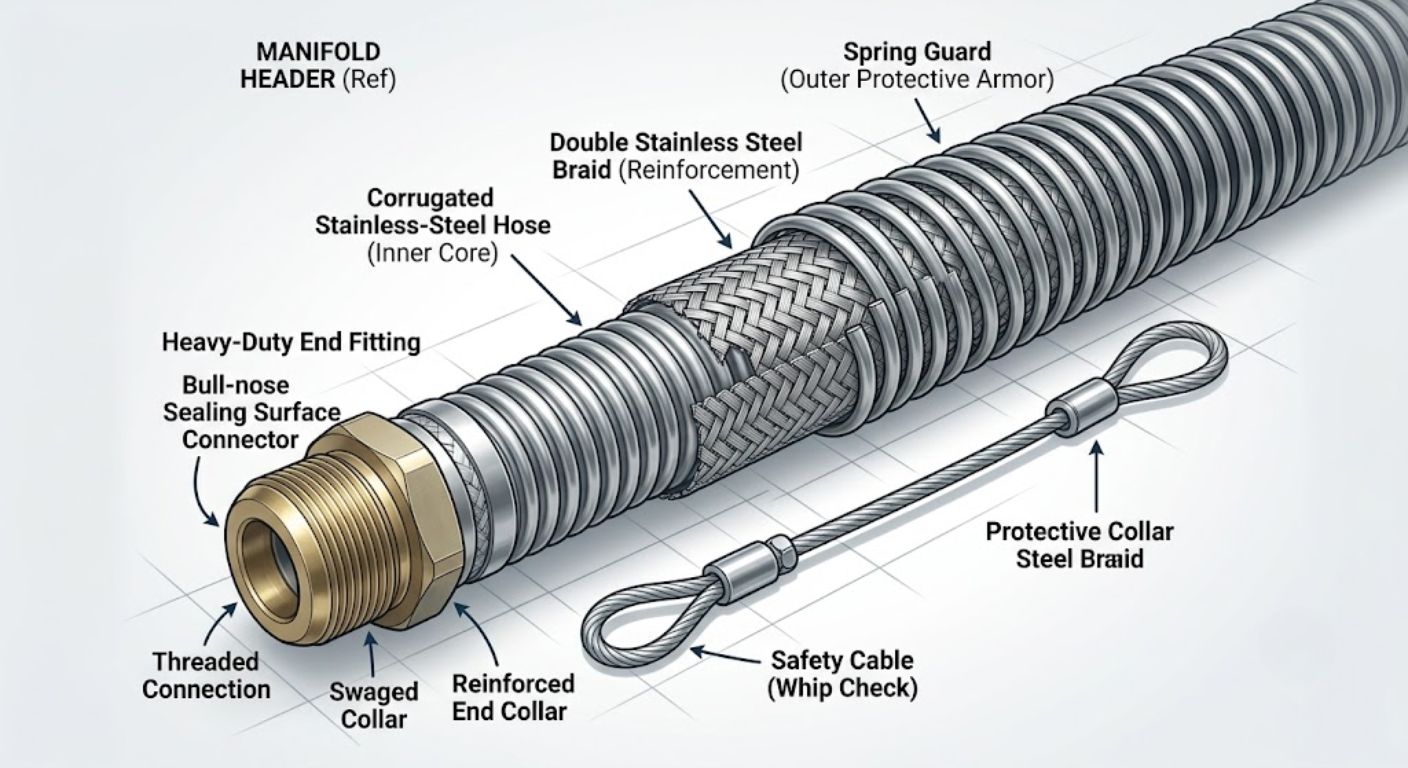
- Damaged stainless-steel braid
- Corrosion
- Kinking or crushing
- Damaged spring guards
- Loose or damaged fittings
- Signs of leakage
- Damaged safety cable
- Contamination with oil, grease or other unsuitable substances
- Unusual movement or vibration during operation
- A hose that has exceeded its manufacturer's inspection or service requirements
A damaged outer braid should not automatically be treated as a cosmetic issue. The reinforcement is part of the hose assembly's mechanical protection.
Research published in Journal of Anaesthesiology Clinical Pharmacology emphasizes that medical gas pipeline systems require careful design, installation, commissioning and operation because failures can have serious consequences.
If a hose, fitting or cylinder connection appears damaged, the appropriate response is to stop the relevant operation according to the plant's safety procedure and have the assembly assessed by qualified personnel.
Root Reasons Behind Hose and Filling-System Problems
1. Incorrect pressure rating
One of the most important selection factors is pressure.
A hose intended for low-pressure oxygen delivery should not automatically be used for high-pressure cylinder filling. The required working pressure, test pressure and safety margin must be appropriate for the application.
The pressure rating should be verified against the manufacturer's technical documentation and the actual operating conditions of the filling system.
2. Incorrect connection or thread
Cylinder valves and manifold connections can vary. A hose may appear physically compatible while having the wrong connection specification.
Before ordering, verify:
- Cylinder valve type
- Connection standard
- Thread specification
- Manifold-side fitting
- Hose length
- Internal diameter
- Gas service
- Operating pressure
3. Poor handling and excessive bending
Flexible does not mean unlimited flexibility.
Repeated sharp bending, twisting or mechanical stress can shorten hose service life and place additional loads on fittings. Proper bend protection and correct routing are therefore important.
4. Contamination
Oxygen service requires careful control of contamination. Oil and grease are particularly important hazards because oxygen supports combustion.
HSE guidance notes that equipment used with compressed oxygen should be free from oil, grease, metal particles, dust and other unsuitable contaminants.
5. Incorrect maintenance or modification
Cutting a hose, changing fittings, using unsuitable sealants or modifying a factory assembly can change the characteristics of the complete connection.
High-pressure oxygen equipment should therefore be maintained according to the manufacturer's instructions and applicable plant procedures.
Science-Backed Safety Practices for Oxygen Hose Systems
Select for oxygen compatibility—not just pressure
Pressure rating alone is not enough.
A hose assembly used for oxygen should be suitable for the specific gas service and operating conditions. Material compatibility, cleanliness and fitting design all matter.
WHO identifies medical oxygen as different from industrial oxygen and emphasizes that medical-use oxygen must meet appropriate specifications for purity and quality.
Keep oxygen-service components clean
One of the most important principles is preventing contamination.
Do not introduce ordinary oils, greases or unapproved lubricants into an oxygen connection. HSE specifically warns that hydrocarbon-based lubricants can be dangerous in oxygen service.
The correct cleaning method should come from the hose manufacturer, gas-system procedure or applicable technical standard. Do not improvise a cleaning method for oxygen-service equipment.
Use appropriate safety restraints
High-pressure flexible hose assemblies can be subjected to considerable mechanical forces if a connection fails.
A suitable safety cable or restraint can provide an additional level of mechanical protection. However, it should never be regarded as a substitute for correct installation, pressure rating and inspection.
Inspect before operation
A practical inspection routine should include:
- Check hose body and braid.
- Check end fittings.
- Check the safety cable.
- Check for visible contamination.
- Confirm correct connection.
- Verify the assembly is not kinked or excessively bent.
- Check that the equipment configuration matches the approved plant procedure.
Inspection intervals should be determined by the manufacturer, plant SOP and applicable regulations rather than relying on a universal replacement period.
Role of the Double-Braided Stainless-Steel Tail Pipe
For applications requiring a flexible, mechanically reinforced connection between oxygen cylinders and a manifold, a double-braided stainless-steel tail pipe can be considered when its specifications match the installation.
The Double Braided SS Flexible High-Pressure Tail Pipe listed by Bajaj Life Care is described as a filling pigtail for connecting oxygen cylinders to a manifold header in oxygen filling stations. The product page specifies a stainless-steel 316L corrugated flexible hose with stainless-steel wire-braid reinforcement, brass bull-nose oxygen-service connectors, spring guards and a parallel wire-rope safety cable.
The listed product configuration includes a 1-metre standard length and 1/4-inch internal bore, with bull-nose connections specified for the cylinder and manifold sides. The product page also states that the assembly is intended for compatible high-pressure oxygen cylinder filling and transfer applications.
Importantly, these specifications should be matched against the actual cylinder valve, manifold connection, pressure and plant requirements before purchase.
For professional applications, you can review the Double Braided SS Flexible High-Pressure Tail Pipe for its stated configuration and technical details.
Important: This product is a high-pressure gas-system component, not a patient-contact oxygen accessory. Installation and servicing should be performed by appropriately trained personnel.
Oxygen Hose Tube Best Practices
Check the complete specification before ordering
Instead of asking only, "What size oxygen hose do I need?", collect the complete system information.
A useful purchasing checklist includes:
| Specification | What to verify |
|---|---|
| Gas | Oxygen / intended gas service |
| Working pressure | Required operating pressure |
| Test pressure | Manufacturer-specified test rating |
| Length | Required connection distance |
| Bore | Required internal diameter |
| Cylinder connection | Valve and fitting specification |
| Manifold connection | Header-side fitting |
| Material | Hose and reinforcement materials |
| Cleanliness | Oxygen-service requirements |
| Temperature | Expected operating range |
| Safety restraint | Cable or approved restraint where required |
This information helps avoid ordering a hose based on appearance alone.
Avoid unnecessary hose movement
The hose should be routed so that it is not exposed to avoidable bending, abrasion, crushing or twisting.
Never use a hose as a lever to align a cylinder or force a misaligned connection into place.
The product guidance for the Bajaj Life Care tail pipe specifically advises using a spanner on the hex rather than twisting the hose during connection.
Follow plant SOPs
A filling plant should have documented procedures covering connection, filling, inspection, emergency isolation and maintenance.
WHO's technical guidance emphasizes the importance of appropriate selection, procurement, maintenance and use of oxygen-system equipment.
Where to Put a Water Trap on Oxygen Tubing?
This is a common search question, but the answer depends on which oxygen system you mean.
A water trap is not a universal component that should simply be inserted into every oxygen line.
In a medical gas pipeline or cylinder-filling system, moisture management should be addressed through the system's design, gas source, filtration/drying arrangements, drainage provisions and manufacturer or engineering specifications.
For patient oxygen delivery, a humidifier may intentionally add moisture to the gas. That is a different application from a high-pressure cylinder filling line.
Therefore, if you are asking where to install a water trap on oxygen tubing, first identify:
- Oxygen source
- Pipeline or cylinder system
- Pressure
- Intended application
- Existing regulator/filter/dryer arrangement
- Manufacturer's instructions
Do not add an improvised water trap to a high-pressure oxygen filling connection.
Contamination and moisture control matter because medical gas systems must maintain appropriate quality throughout distribution. Published literature has documented contamination concerns in medical gas pipelines, reinforcing the need for controlled installation and maintenance procedures.
Which Pipe Is Used for Oxygen Supply in a Hospital?
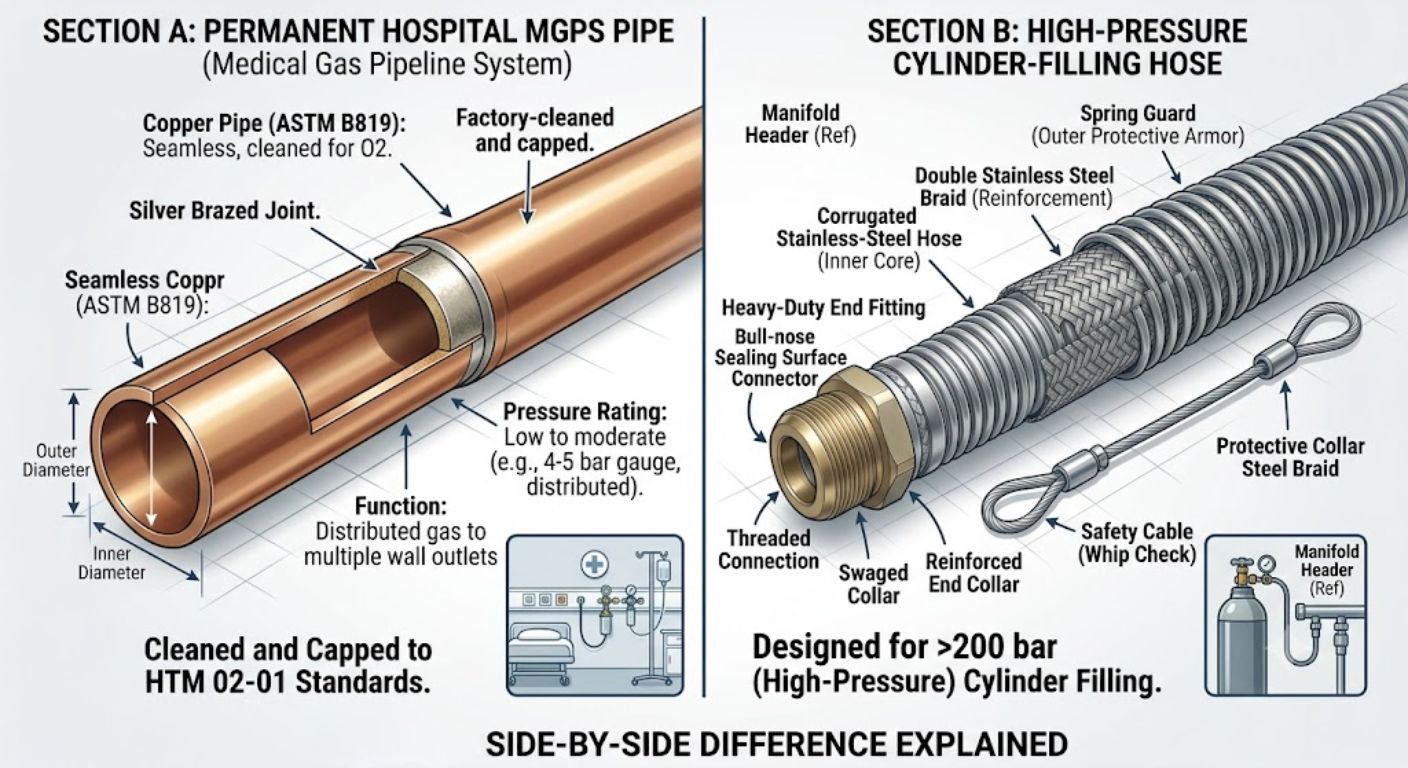
Hospital oxygen supply is different from an oxygen cylinder-filling hose.
For a medical gas pipeline system, the pipe material and construction must meet the applicable medical-gas standard and project specification. WHO's 2024 technical specifications identify copper, Monel or another appropriate ignition-resistant alloy as acceptable piping materials under the specified requirements, with piping dimensions and joining methods selected according to applicable standards.
Copper is widely associated with medical oxygen pipeline installations, but the correct answer for a particular hospital depends on the applicable national/international standard, system design and project specification.
A hospital MGPS may include:
- Central oxygen source
- Primary and reserve supply
- Manifold system
- Pressure regulation
- Copper or other approved pipeline
- Isolation valves
- Area valve service units
- Pressure gauges
- Alarms
- Terminal units
- Patient-side equipment
This is why a high-pressure filling pigtail should not be confused with the permanent pipeline installed throughout a hospital.
When Should You Involve a Doctor or Medical-Gas Professional?
For this topic, there are two different professionals to consider.
For patient-care questions
If your question concerns a patient's oxygen requirement, flow rate, oxygen saturation or oxygen therapy, consult the treating doctor or qualified healthcare professional. A hose or pipeline component should never be used to make a clinical decision.
WHO identifies oxygen as an essential medicine and stresses the importance of safe, quality-assured oxygen systems.
For filling-plant or hospital infrastructure questions
For high-pressure cylinder filling, manifold installation, medical gas pipeline work or hose replacement, involve a qualified medical-gas engineer, gas-system technician or other competent professional.
Seek professional inspection when:
- A hose develops a leak.
- A fitting is damaged.
- The braid is damaged.
- The connection does not match.
- Pressure behaviour is abnormal.
- Contamination is suspected.
- The hose has been modified.
- You are unsure whether a component is approved for oxygen service.
High-pressure oxygen systems should not be treated as DIY installations.
An oxygen filling hose is a flexible high-pressure connection used in a suitable oxygen cylinder filling or gas-transfer system. It can connect an individual cylinder to a filling manifold or compatible high-pressure equipment. The hose itself does not control pressure; pressure management depends on the complete system, including valves, regulators, manifold design and filling equipment.
Hospital oxygen pipeline systems commonly use approved metallic piping such as copper, subject to the applicable medical-gas standard and project specification. WHO technical specifications identify copper, Monel or other appropriate ignition-resistant alloys for specified medical gas pipeline applications. The correct material, wall thickness, joining method and installation must follow the applicable standard and engineering design.
There is no universal location for a water trap on every oxygen system. Its use and location depend on the oxygen source, pressure, system design and manufacturer's instructions. A water trap should not be improvised on a high-pressure cylinder-filling connection. Moisture management should be addressed through the approved design of the specific oxygen system.
Check the gas service, working and test pressure, hose length, internal diameter, cylinder valve, manifold connection, thread specification, material compatibility and oxygen-service cleanliness requirements. You should also verify the hose's suitability with the complete system rather than relying only on a nominal size. For high-pressure applications, trained personnel should confirm compatibility before installation.
No. Low-pressure tubing intended for patient oxygen delivery should not automatically be used for high-pressure cylinder filling. Cylinder filling requires a hose assembly specifically suitable for the operating pressure, gas service, fittings and application. Using the wrong hose can create leakage, mechanical or safety risks. Always follow the filling plant's technical specifications and the hose manufacturer's stated application.
Frequently asked questions
Here are some common questions about our company.
Conclusion
A hose used in an oxygen filling system is a critical connection—not simply a piece of flexible tubing. Correct selection requires attention to pressure rating, oxygen compatibility, fittings, hose construction, cleanliness, routing and inspection.
For cylinder-filling applications, a suitable reinforced tail pipe can provide the flexibility needed between individual cylinders and a manifold while maintaining the mechanical characteristics required by the application. However, the exact hose specification must always be matched to the cylinder valve, manifold, operating pressure and applicable safety requirements.
If you are sourcing a high-pressure oxygen filling connection, review the technical specifications carefully and consult your gas-system professional where necessary. You can explore the Double Braided SS Flexible High-Pressure Tail Pipe from Bajaj Life Care for its stated configuration and application details.
Safe oxygen handling starts with the right component, the right specification and the right installation procedure.