
Home oxygen therapy has become a vital component of respiratory care across India. Whether managing chronic conditions like Chronic Obstructive Pulmonary Disease (COPD), pulmonary fibrosis, or recovering from acute respiratory illnesses, having the right equipment at home is essential for patient recovery and comfort. Among the various home oxygen therapy solutions available, stationary oxygen concentrators are the most reliable and cost-effective devices. However, when buying or renting one, families and healthcare providers often face a critical question: Should you choose a 5 LPM or a 10 LPM model?
Understanding the distinction between a 5 litre vs 10 litre oxygen concentrator goes beyond just picking a larger machine. It involves evaluating oxygen concentration purity, outlet pressure, power consumption, and most importantly, the clinical prescription provided by a physician. In this detailed guide, we will break down how these devices work, compare their key specifications, and help you make an informed decision for home care or clinical deployment.
Understanding Oxygen Concentrator Flow Rate
Before diving into the comparison, it is crucial to understand what the term LPM means. LPM stands for Litres Per Minute. The oxygen concentrator flow rate indicates the volume of purified oxygen the machine can deliver to the patient in one minute.
An oxygen concentrator operates by taking ambient air—which naturally consists of roughly 78% nitrogen, 21% oxygen, and 1% other gases—and filtering it through internal molecular sieve beds. These synthetic zeolites absorb the nitrogen under pressure, allowing oxygen-enriched air (typically 90% to 96% purity) to be delivered through a nasal cannula or oxygen mask.
The flow rate setting on the machine directly dictates how much continuous oxygen flow the patient receives:
- 5 LPM Concentrator: Delivers adjustable oxygen flow from 0.5 up to 5 litres per minute.
- 10 LPM Concentrator: Delivers adjustable oxygen flow from 1 up to 10 litres per minute.
According to clinical guidelines outlined by health authorities such as the World Health Organization (WHO) and the Indian Council of Medical Research (ICMR), supplemental oxygen must always be titrated to maintain the patient's blood oxygen saturation (SpO2) within target therapeutic ranges (usually 92% to 96% for standard respiratory patients, or 88% to 92% for hypercapnic COPD patients).
What is a 5 LPM Oxygen Concentrator?
A 5 LPM oxygen concentrator is the standard workhorse of home oxygen therapy. It is engineered for patients requiring mild to moderate supplemental oxygen support. For the vast majority of long-term home oxygen therapy (LTOT) patients, a 5 litre unit offers the perfect balance of portability, energy efficiency, and reliable oxygen output.
Key Features of 5 LPM Units
- Flow Range: Typically 0.5 LPM to 5.0 LPM.
- Oxygen Purity: Maintains 90% to 96% oxygen purity across all flow settings (1 to 5 LPM).
- Weight & Mobility: Weighs between 14 kg to 18 kg, making it easier to roll between rooms on built-in caster wheels.
- Power Consumption: Generally consumes between 280 Watts to 350 Watts, keeping electricity costs manageable for continuous household run times.
- Noise Level: Operates quietly, usually under 45 decibels, which ensures minimal disturbance during sleep.
Ideal Clinical Applications
A 5 LPM unit is usually prescribed for patients suffering from moderate COPD, mild asthma, early-stage interstitial lung disease (ILD), post-COVID respiratory recovery, or age-related hypoxemia where flow requirements rarely exceed 3 to 4 litres per minute.
What is a 10 LPM Oxygen Concentrator?
A 10 LPM oxygen concentrator is a heavy-duty, high-flow medical device designed for patients with advanced or severe respiratory distress who require high oxygen volumes and higher delivery pressures. While it operates on the same basic zeolitic separation technology, its internal components—such as the compressor, cooling system, and sieve beds—are significantly larger and more robust.
Key Features of 10 LPM Units
- Flow Range: Typically 2.0 LPM up to 10.0 LPM.
- High Outlet Pressure: Operates at higher outlet pressures (around 12 to 20 PSI or 80–138 kPa), which allows for longer tubing runs, tracheostomy collars, or connection to specialized high-flow delivery interfaces.
- Dual Flow Option: Many 10 LPM models feature dual flow meters, allowing two patients to split the output simultaneously (e.g., two patients receiving 5 LPM each), which is highly beneficial for clinics, nursing homes, and B2B medical supply settings.
- Weight & Size: Considerably heavier, weighing between 23 kg to 28 kg due to the larger compressor and dual sieve columns.
- Power Consumption: Consumes around 500 Watts to 650 Watts of power.
Ideal Clinical Applications
A 10 LPM unit is recommended for severe pulmonary fibrosis, advanced ARDS (Acute Respiratory Distress Syndrome), high-flow requirements during acute pulmonary exacerbations, or situations where high-pressure accessories like nebulizers or humidified high-flow systems are attached.

Comparing 5 Litre vs 10 Litre Oxygen Concentrators
When evaluating a 5 litre vs 10 litre oxygen concentrator, comparing technical specifications directly helps in making the right practical and financial choice:
1. Oxygen Output and Capacity
The primary distinction is volume capability. If a patient is prescribed 4 LPM, a 5 LPM machine will suffice. However, running a 5 LPM machine continuously at its maximum capacity (5 LPM) can cause the compressor to work harder, generating more heat. If a patient's prescription is expected to escalate, or if they regularly need 5 LPM, doctors often advise stepping up to a 10 LPM unit so the machine operates comfortably at mid-range capacity.
2. Outlet Pressure and Tubing Length
Standard 5 LPM concentrators deliver oxygen at lower pressures (around 5 to 9 PSI). If you extend the oxygen tubing beyond 25 to 50 feet, the pressure drops, reducing the delivered flow rate. In contrast, 10 LPM concentrators deliver higher output pressure (12 to 20 PSI), enabling the use of longer tubing (up to 100 feet) without sacrificing flow delivery. This allows the patient to move freely around a large home while the machine stays in one central room.
3. Power Consumption and Operating Costs
In Indian households where continuous power supply and running costs are significant factors, power consumption matters. A 5 LPM machine typically consumes around 300W, whereas a 10 LPM unit consumes around 600W—nearly double the electricity. Furthermore, backing up a 10 LPM concentrator requires a higher-capacity home inverter or generator (at least 1.5 kVA to 2 kVA with pure sine wave output) to handle the startup surge of its heavier compressor.
4. Portability and Machine Size
Both types are stationary home models equipped with wheels. However, moving a 15 kg 5 LPM unit over small thresholds, rugs, or domestic ramps is noticeably easier than maneuvering a bulky 26 kg 10 LPM unit. If space or mobility is a primary concern, the smaller footprint of a 5 LPM unit offers a clear advantage.
Summary Comparison Table
- Maximum Flow Output: 5 LPM vs 10 LPM
- Average Oxygen Purity: 93% ± 3% (Both)
- Average Weight: 14–18 kg (5 LPM) vs 22–28 kg (10 LPM)
- Power Usage: ~300 Watts (5 LPM) vs ~600 Watts (10 LPM)
- Typical Output Pressure: 5–9 PSI (5 LPM) vs 12–20 PSI (10 LPM)
- Dual Flow Capability: Rare (5 LPM) vs Common (10 LPM)
- Ideal For: Mild-to-moderate LTOT vs Severe respiratory conditions & clinical split-use
How to Make the Right Choice
When choosing between these two capacities, keep these essential steps in mind:
- Follow the Doctor's Prescription: Never buy an oxygen concentrator without a formal prescription specifying required LPM flow rate and daily usage hours.
- Account for Peak Demand: If your physician anticipates that oxygen demand may increase during nighttime sleep, exercise, or condition flare-ups, factor in a buffer margin.
- Consider Dual Patient Needs (For Facilities): For B2B healthcare buyers, clinics, or nursing homes, a 10 LPM unit with dual-flow capabilities offers greater operational flexibility and cost savings compared to purchasing two separate 5 LPM machines.
- Verify Local Service Support: Ensure that the chosen brand (whether imported or domestically manufactured) offers localized service, ready availability of replacement filters, sieve beds, and prompt technical support across India.
Essential Safety and Maintenance Practices
Regardless of whether you choose a 5 LPM or 10 LPM model, proper maintenance ensures long machine life and safe oxygen delivery:
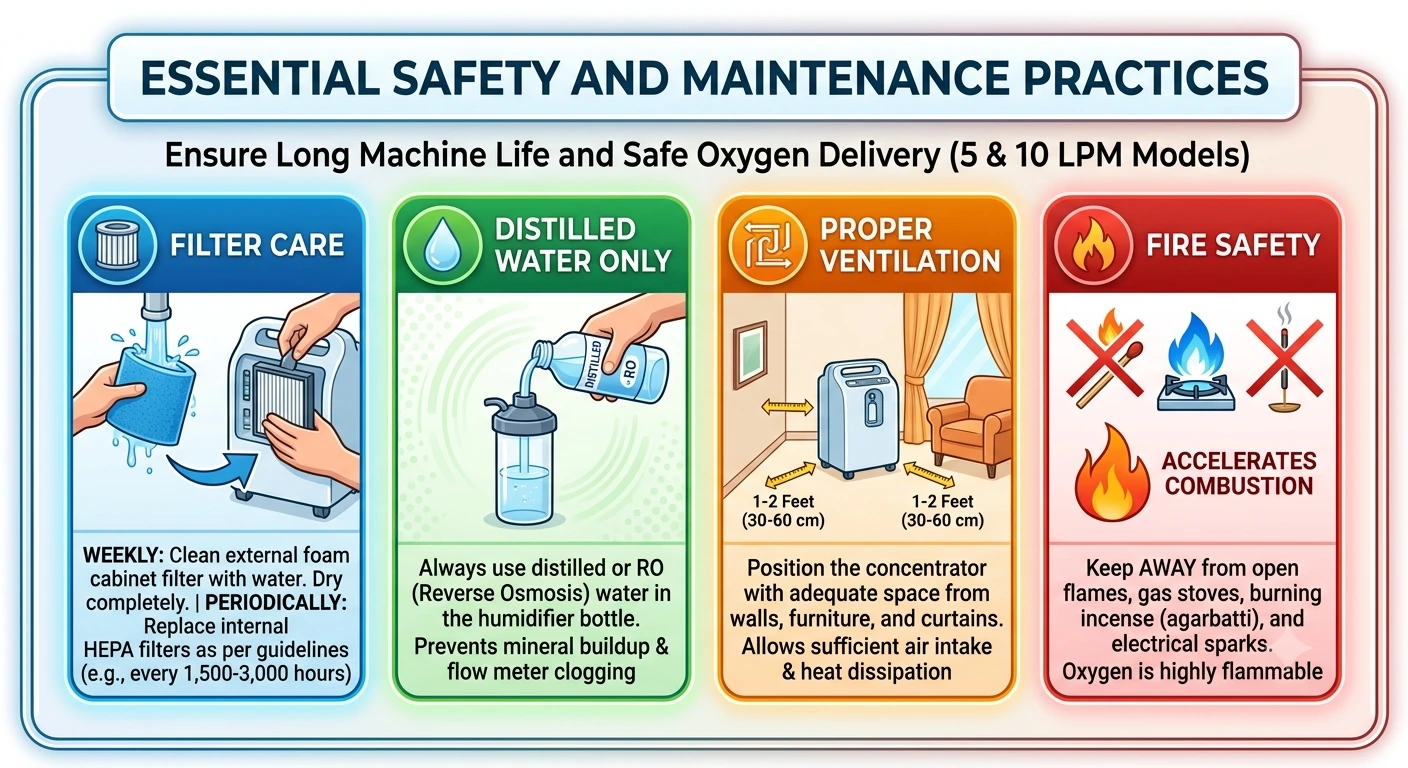
- Filter Care: Clean the external foam cabinet filter weekly under running water, dry it completely, and reinsert it. Replace internal HEPA filters as per manufacturer guidelines (usually every 1,500 to 3,000 hours).
- Distilled Water: Always use distilled or RO water in the humidifier bottle to prevent mineral buildup and clogging in the flow meter.
- Ventilation: Position the concentrator at least 1 to 2 feet away from walls, curtains, and furniture to allow adequate air intake and heat dissipation.
- Fire Safety: Keep the oxygen concentrator away from open flames, gas stoves, burning incense sticks (agarbatti), and electrical sparks, as concentrated oxygen accelerates combustion rapidly.
By understanding your precise therapeutic requirements and evaluating oxygen concentrator flow rates thoroughly, you can select a reliable device that delivers safe, optimal respiratory support at home or in medical facilities.
Disclaimer: This article is for informational and educational purposes only and does not substitute for professional medical advice, diagnosis, or treatment. Oxygen therapy must always be administered under the strict supervision and prescription of a qualified healthcare professional.